Red Fish Noodles
October 17, 2022
Red Rice Yogurt Drink
November 8, 2022Rice has been a staple food in Asian countries and the global consumption of rice increased slightly from 437.18 million metric tonnes in 2009 to 504.3 million metric tonnes in 2021. In the 2017/2018 crop year, India had the largest harvest area of rice, at 43.79 million hectares, whereas China harvested 30.18 million hectares.10
White rice is the most widely consumed rice while there are other pigmented rice varieties which include red, black, and purple. The pigmented or coloured rice is unpolished rice that retains some pigments after removing only the husk and a small amount of the outer layer, while the embryo is typically white.1
Red rice has a bran layer ranges from light to dark red. One of the major functional components of red rice is anthocyanin, which is a type of flavonoid. In this article, red rice varieties in selected countries will be reviewed in terms of their nutritional content and health benefits.
India
There is a plethora of red rice varieties that are commonly found in India, and their use is common among practitioners of traditional medicine and communities as part of their cultural heritage. Himalayan red rice; Matta rice, Kattamodon, Kairali, Jyothy, Bhadra, Asha, Rakthashali of Kerala; Red Kavuni, Kaivara Samba, Mappillai Samba, Kuruvi Kar, Poongar of Tamil Nadu, and others are among the coloured varieties.5 Himalayan red rice (Figure 1) is nutty in flavor and slightly chewy in texture.
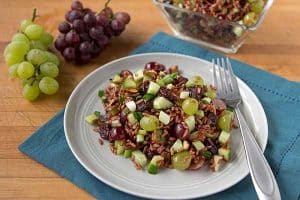
Figure 1: Himalayan red rice salad with nuts and fruits
Traditionally, Ayurvedic physicians consider red rice as a nutritive food and medicine, therefore it is consumed as a whole grain.5 Red rice varieties have been used to treat conditions such as diarrhoea, vomiting, fever, haemorrhage, chest pain, wounds, and burns.2
According to Ahuja et al. (2008), red rice varieties from Jharkhand and Chattisgarh such as Bhama, Danigora, Karhani, Kalmdani, Ramdi, Muru, Hindmauri, and Punaigora are nutritious and provide energy and satiety throughout the day.Maapillai Samba, a kind of red rice from Tamil Nadu, has higher amount of total polyphenolic compounds (294 mg/100g) and anthocyanin content (6.5 mg/100g) than the varieties from Sri Lanka and China red rice.6,9
In addition, Njavara “black glumed” type (Figure 2) is considered as a medicinal rice variety in India. Mohanlal et. al. (2011) reported the total oryzanol, phenolic, flavonoid, proanthocyanidin and phytate contents of Njavara “black glumed” type (1.84 mg/g, 27.16 mg of gallic acid/g, 4.50 mg of quercetin/g, 0.98 mg of catechin/g and 8.77 mg/g dry weight of bran, respectively). The bran of this rice variety showed greater reducing power and significantly higher scavenging activity with 2, 2-diphenyl-1-picryl hydrazyl radical, superoxide and hydrogen peroxide with values of concentration of its rice required to scavenge 50% of respective radicals (IC50): 84.66, 203.16 and 73.55 mg/mL, respectively.3

Figure 2: Niavara Rice
Thailand
In Thailand, non-glutinous varieties of husked rice with red pericarp have many names which include Thai red cargo, red rose, Sang Yot Phattalung, Thubthim Chum Phae, Hom Kulap Daeng, Hom Daeng (Red Hom Mali), Sin Lek, Hom Kra Dang Nga 59, and Mali Komen Surin.1 Thubthim Chum Phae (Figure 3) is classified as short-grain rice that becomes as red as pomegranate seeds after cooked.According to Thai Rice Department (2017), this rice variety is high in flavonoids (5,233 mg/100g) and phenolic content (7,048 mg/100g). It contains 25 mg/100g, 610 mg/100g and 812 mg/100g of omega-3, omega-6 and omega-9, respectively. Meanwhile, red rose rice, Red Hom Mali and Sin Lek contain minerals like iron, calcium and zinc.
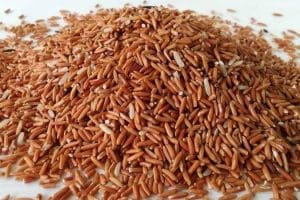
Figure 3: Thubthim Chum Phae
Malaysia
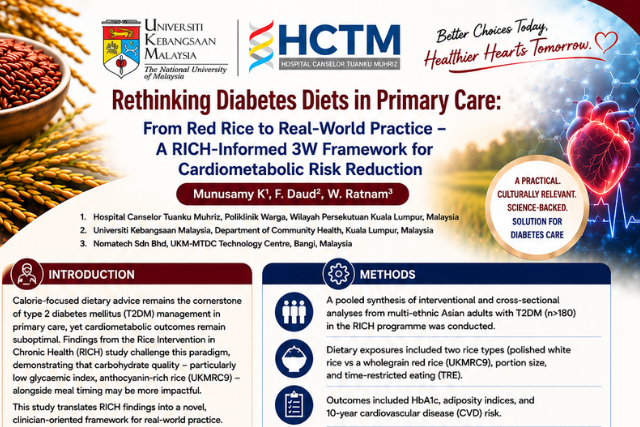
White rice remains the most consumed rice in Malaysia, followed by brown rice, fragrant rice, Basmati, Ponni, glutinous rice and red rice. Red rice varieties include Udang Besar, Udang Halus, Silah Merah, Katek Merah, MRQ98, MRQ99, MRQ100 and UKMRC-9.
In 2016, a group of scientists from National University of Malaysia (Se et al., 2016) compared the postprandial glucometabolic responses to three crossbred red rice variants (UKMRC-9, UKMRC-10, UKMRC-11) against three selected commercial rice types (Thai red, Basmati white, Jasmine white). They reported the lowest to highest trends for glycaemic and insulin indices were similar i.e., UKMRC-9 < Basmati < Thai red < UKMRC-10 < UKMRC-11 < Jasmine.
Furthermore, UKMRC-9 (glycaemic index = 46) was categorized as low glycaemic index and lowering the glycaemic index of the diet may contribute to improved glycaemic control in diabetes management.8,12 On the other hand, Sani et al. (2018) reported that UKMRC-9 had significantly higher total phenolic content compared to brown and non-pigmented rice samples.

Figure 4: Red rice in Malaysia
France
French red rice (also called “Le Riz Rouge”) is a red rice variety cultivated in Camargue, a south-eastern region in France. It is similar to brown rice with its longish grain and nutty flavor. The colour of French red rice will turn deeper red when cooked and its texture is firmer and less sticky than brown rice.
Pereira-Caro et al. (2013) analysed the phytochemical profiles of black, red, brown, and white rice from the Camargue region of France. French red rice (Figure 5) had a high amount of oligomeric procyanidins (0.2 mg/g), which accounted for more than 60% of secondary metabolite content, with carotenoids and Ƴ-oryzanol accounting for 26.75%, whereas flavones, flavonols, and anthocyanins accounting for 9%.
Summary
- India has the most extensive red rice varieties and red rice is used by Ayurvedic physicians as a health food or for medicinal uses
- Thai red rice is high in flavonoids and phenolic content
- Malaysia red rice is low in glycaemic index
- French red rice contains secondary metabolites and carotenoids
Guest author : Asst. Prof. Dr. Tan Choon Hui (UCSI University)
References
- Sani, N. A., Sawei, J., Ratnam, W., & Abdul Rahman, Z. (2018). Physical, antioxidant and antibacterial properties of rice (Oryza sativa) and glutinous rice (Oryza sativa var. glutinosa) from local cultivators and markets of Peninsular, Malaysia. International Food Research Journal, 25(6), 2328–2336.
- Se, C. H., Chuah, K. A., Mishra, A., Wickneswari, R., & Karupaiah, T. (2016). Evaluating crossbred red rice variants for postprandial glucometabolic responses: A comparison with commercial varieties. Nutrients, 8(5).
- Sompong, R., Siebenhandl-Ehn, S., Linsberger-Martin, G., Berghofer, E. (2011). Physicochemical and antioxidative properties of red and black rice varieties from Thailand, China and Sri Lanka. Food Chemistry, 124:132–40.
- Statista. 2021. Total rice consumption worldwide from 2008/2009 to 2020/2021 (in 1,000 metric tons).
Related posts