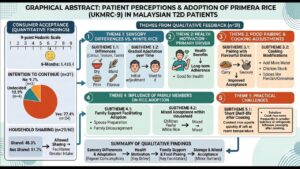
Background: Cardiovascular diseases (CVD) remain the leading cause of death among Type 2 Diabetes (T2D) patients. High glycemic index (GI) white rice is known to increase CVD risk, whereas pigmented rice, with its low GI and antioxidant properties, holds therapeutic potential.
Objective: This study evaluates the effects of substituting white rice with anthocyanin-rich, red pigmented rice (UKMRC9) on cardiometabolic parameters in T2D patients.
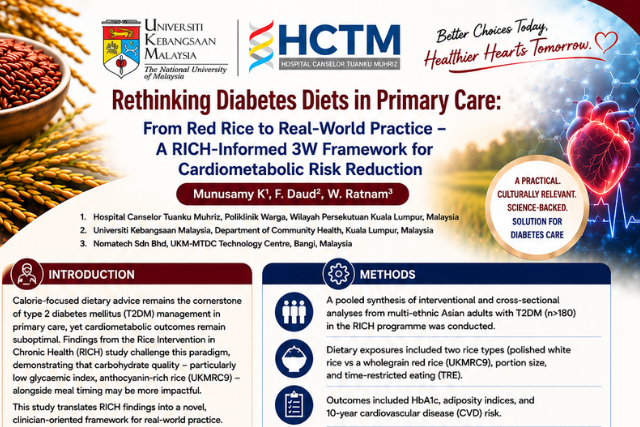
Methods: The Rice Intervention in Chronic Health (RICH) study was a 24-week, multi-center, open- label, parallel-group, randomized controlled trial involving 101 Malaysian adult T2D patients. Eligible participants, who were habitual white rice consumers with poorly controlled T2D, were randomly assigned to either UKMRC9 (treatment) or white rice (control) group. Assessments were conducted at baseline, 12th and 24th weeks. Generalized estimating equations were employed to compare changes in study parameters: adiposity, glycaemic, insulin, and inflammatory markers, lipid profiles, blood pressure, and 10-year CVD risk, over time between treatment and control groups. Intention- to-treat analysis was utilized to evaluate the effectiveness of UKMRC9 under real-world condition. Path analysis was conducted to explore the putative mechanism while dose-response analysis and linear-programming were performed to determine the minimum UKMRC9 intake for optimal cardiometabolic health.
Results and Conclusion: Significant and progressive reductions in adiposity indices, glycaemic markers, insulin resistance, and the 10-year CVD risk (al p<0.05) were observed in the treatment group from baseline to the 12th and 24th weeks of intervention. Conversely, no significant changes were noted in these parameters in the control group (p>0.05). The effect of UKMRC9 on 10-year CVD risk reduction was significantly mediated by glycemic markers (SIE=-2.978, p=0.024). At least 40g/d (raw weight) of UKMRC9 was required for its optimal cardiometabolic effects. Substituting white rice with UKMRC9 significantly improves key cardiometabolic parameters in T2D patients, suggesting its potential as an effective staple food for diabetes management.
Zinc, a nutrient found throughout your body, helps your immune system and metabolism function. Zinc is also important to wound healing and your sense of taste and smell. With a varied diet, your body usually gets enough zinc. The value of zinc is 2.8mg/100g.
Rich in fiber and resistant starch to support a healthier digestive system from the inside out. It helps nourish beneficial gut bacteria, promotes smoother digestion, improves regularity, and keeps you feeling fuller for longer. A healthier gut also contributes to better overall wellness, immunity, and everyday vitality.
Antioxidants are substances that may protect your cells from free radicals, which may play a role in heart disease, cancer, and other diseases. Free radicals are molecules that are produced when your body breaks down food or when you are exposed to tobacco smoke or radiation.
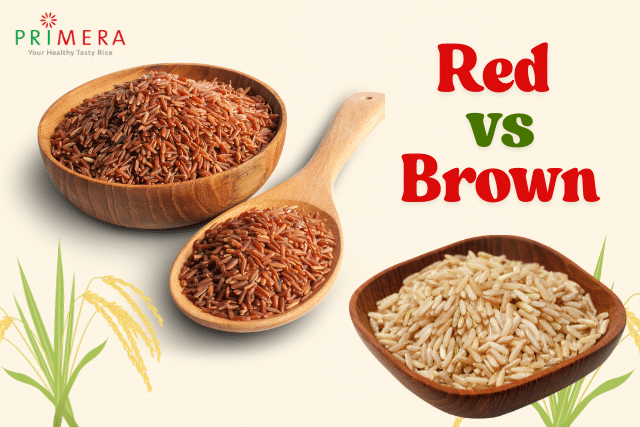
Primera® Red Rice, known as UKMRC9, has a low glycaemic index value (41-48%) which helps to lower and stabilize your after-meal blood glucose level.
Low-GI foods have a GI score of less than 55. They contain carbohydrates that take longer for the body to digest than high-GI foods.
Low-GI foods cause blood sugar levels to rise more slowly than moderate- or high-GI foods.
| Item | Remarks |
| Certificate of Analysis (CoA) | Available upon request |
| Clinical Validation in Type 2 Diabetes Patients | 24-week clinical study completed |
| Low Glycaemic Index (GI 46) | Scientifically Proven |
| High Antioxidant | Natural anthocyanin |
| High Resistant Starch | Laboratory Tested |
| Single Variety Paddy | New Plant Variety (NPV) |

Please click the button below to download our latest brochure.
[Download] Official Primera Brochure
[Download] Primera Rice Cooking Guideline
[Download] Primera Rice Quick Facts
Thank you for your interest in Primera.